
Silicone Rubber Heaters
When using these flexible and versatile heaters, the ability to apply heat exactly where required is limited only by imagination —and a maximum operating temperature of about 200°C (392°F).

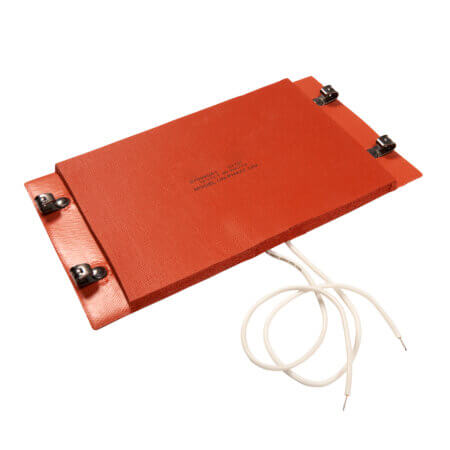
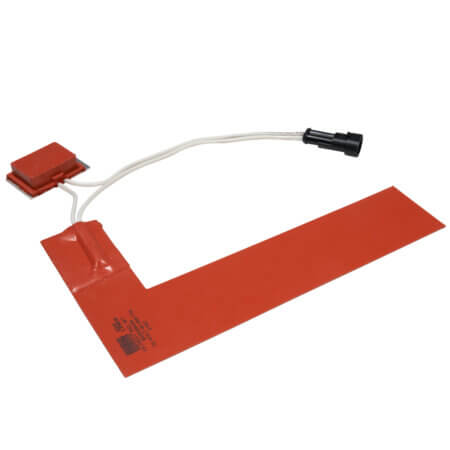

Silicone Rubber Heater Specifications
- UL rated with a maximum continuous operating temperature of 200°C (392°F)
- Thermally stable to 232°C (450°F) continuous operation
- Intermittent temperatures up to 316°C (600°F)
- Remains flexible at -57°C (-70°F)
- High Dielectric Strength 400 to 600 volts per mil of thickness
- Flammability Rating: Horizontal burn rated (UL 94 HB)
- Environmentally Stable Resistant to:
- Ozone
- Moisture
- Many chemicals, including those common in the environment
- Vibration, mechanical and thermal shock
- Ripping, stretching, separation
Environmentally Stable Resistant to
- Ozone
- Moisture
- Many chemicals, including those common in the environment
- Vibration, mechanical and thermal shock
- Ripping, stretching, separation
Options
- Molded to shape
- Thermostats (part or air sensing)
- Thermocouples
- Factory Bonding
- PSA (pressure sensitive adhesive backing)
- Lead options
- Cords, plugs, connectors and others

There are unlimited applications across many industries for our custom silicone rubber heaters which include:
Sonic Cleaning
Enclosure Heating
Anti-freezing
Traffic signal boxes
Lyopholizer
Display Cases
Battery Heating
Composite Repair
Lab Equipment
Warming trays
Food Service Equipment
Medical Freeze Dryer
Military Satellites, Targets, Hot Air Balloons
EV Battery Heaters
Medical applications
Veterinary tables
Printing industry
Telecommunications
Food Processing Equipment
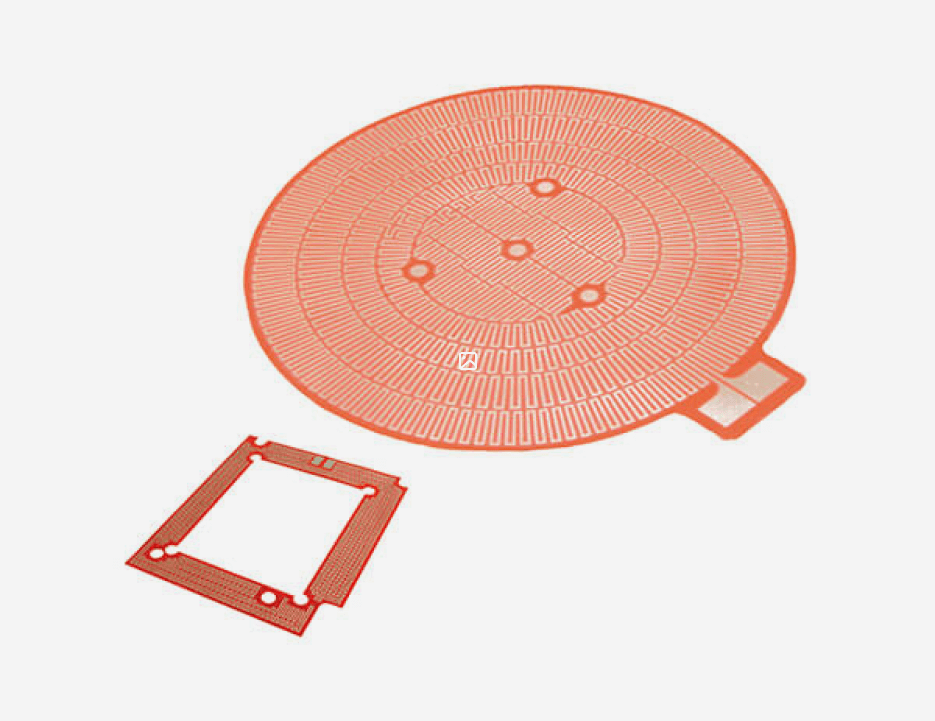
Etched Foil Silicone Rubber Heaters
Our designers use custom software to calculate the configuration of the heating element, given the voltage, wattage and resistance. Nickel alloy foil is acid-etched in the resulting pattern. The foil is then vulcanized to the silicone rubber sheath material.
The etched element provides superior heat transfer and exceptionally uniform heat output, resulting in a faster warm-up cycle and longer life. These flexible heaters operate in ambient temperatures from -80°F to 500°F.
Advantages over wire wound silicone rubber heaters
- Distributed wattage
- Complex heat distribution
- Edge loss compensation
- Accurate reproduction of complex circuits
- Greater element area over heater sheath

Wire Wound Silicone Rubber Heater
A fine nickel-chromium alloy wire is spiraled onto a center core of fiberglass twine, producing a strong, flexible heating element. Electronically controlled precision winding equipment ensures consistency.
Circuits are then hand-wound on permanent tooling, providing repeatability of resistance and pattern. Parallel circuits are utilized where possible, permitting continued operation should a single circuit be damaged. When the heating element is positioned, a second layer of silicone rubber is laid over the wire.
The layers are then vulcanized to permanently position the circuits.
Wire wound advantages over etched foil element:
- Faster turnaround time on prototype designs
- Lower engineering cost
- More economical pricing at lower quantities